

You can sleep with a heated blanket, but you need to consider safety and comfort before you do. Many people worry about risks like fire, burns, or heatstroke. Others feel unsure if a heated blanket is right for them, especially those with nerve damage or poor blood circulation.
Most users enjoy the warmth and relaxation, but you should always think about your own health and needs when choosing how to sleep.

How do electric blankets work?
Electric blankets use insulated heating wires that are built safely into the fabric. Once switched on, these wires generate and spread heat across the blanket for consistent warmth. The wires are connected to a control unit, so you can choose the temperature that feels most comfortable. A thermostat helps regulate the heat by controlling the electrical current flowing through the wires. Because of this, electric blankets offer adjustable comfort, can cost less than heating an entire room, and are a great way to stay warm and relax in the evening or fall asleep more comfortably.
Heated Blanket Safety

Electric Blanket Safety Features
When you choose a heated blanket, you benefit from advanced safety features that protect you during use. Manufacturers design modern electric blankets to meet current safety standards, reducing risks and improving reliability. You should look for products with the following features:
|
Safety Feature |
Description |
|---|---|
|
Regulates heat to prevent burns or discomfort. |
|
|
Auto-off Timer |
Turns off the blanket after a set time to prevent overheating and conserve energy. |
|
Construction Standards |
Ensures heating elements are protected and meet safety standards from regulatory organizations. |
|
Safety Labels |
Provides instructions and warnings for safe usage. |
|
Automatic Shut-off |
Turns off the blanket if it overheats or after a preset time, reducing fire hazards. |
|
Overheat Protection |
Sensors monitor temperature and shut down the blanket if it exceeds safe limits. |
|
Low Voltage Technology |
Operates on lower voltage to minimize electric shock risks. |
|
Waterproof Features |
Protects electrical components from moisture, enhancing safety. |
You should always check for certifications before purchasing. These certifications confirm that the heated blanket meets strict safety standards:
|
Certification |
Description |
|---|---|
|
UL (Underwriters Laboratories) |
Indicates the blanket has been tested for electrical safety and fire risks. |
|
ETL (Intertek Testing Services) |
Signifies the product meets minimum safety standards through independent testing. |
|
CE (Conformité Européenne) |
Indicates compliance with EU safety, health, and environmental protection requirements. |
Tip: Always read the safety labels and instructions before using your heated blanket. Certified products offer greater peace of mind and align with current safety standards.

SINOSHINE Heated Blanket
Quality and safety are at the core of our production. All Sinoshine products comply with international certifications such as CE, UL, and RoHS, ensuring confidence for distributors and end-users alike. With a proven track record in OEM and ODM projects, we support global brands in expanding their product lines with reliable heated solutions.
Who Should Avoid Heated Blankets
Not everyone should use a heated blanket. Certain groups face higher risks due to medical conditions or age. You need to consider your health before using one. The following groups should avoid heated blankets:
- Infants
- Elderly
- Diabetics
- Pregnant women
- Those with nerve disorders
If you belong to any of these groups, consult your doctor before using a heated blanket. For example, diabetics may have reduced sensation in their skin, which increases the risk of burns. Older adults often have altered temperature receptors, making it harder to detect overheating. Pregnant women should exercise caution, as some studies raise concerns about non-ionizing radiation, though the World Health Organization finds no confirmed increased risk.
Common Safety Myths
You may encounter several myths about electric blanket safety. Understanding the facts helps you make informed decisions. Here is a comparison of common myths and scientific evidence:
|
Myth |
Evidence |
|---|---|
|
Electric blankets cause cancer due to EMFs |
Research shows electric blankets emit low- to mid-frequency EMFs, which are non-ionizing and do not damage cells or DNA. No link to cancer exists. |
|
Electric blankets are unsafe for diabetics |
Diabetics with neuropathy may not feel heat, risking burns. Doctors often advise against use for this group. |
|
Older adults can safely use electric blankets |
Older adults may have impaired temperature receptors, increasing burn risk. Medical advice is recommended. |
|
Electric blankets are safe during pregnancy |
Some studies suggest a possible link between non-ionizing radiation and pregnancy loss, but the WHO states there is no confirmed increased risk. |
|
Electric blankets are safe if used correctly |
Proper use and storage make electric blankets generally safe, but certain populations should avoid them. |
You should rely on products that meet current safety standards and follow manufacturer guidelines. Most modern heated blankets include features that address past concerns, making them safer than older models. Always prioritize your health and comfort when deciding whether to use a heated blanket.
Benefits of Heated Blankets for Sleep

Comfort and Warmth
You want your bed to feel inviting and cozy, especially during cold nights. Heated blankets deliver consistent warmth, creating a soothing environment that helps you unwind after a long day. Many users describe the sensation as stepping into a "toaster oven," which makes falling asleep easier and more enjoyable. Heated blankets offer warmth even without electricity, making them versatile for different situations. You can adjust electric blankets to your ideal sleeping temperature, ensuring comfort without overheating.
- Heated blankets provide warmth quickly, so you do not have to wait for your bed to heat up.
- You can customize the temperature for personal comfort, avoiding discomfort from excessive heat.
- Heated blankets outperform traditional bedding by maintaining warmth throughout the night.
Tip: Gradually adjust the settings to find your ideal sleeping temperature. This approach prevents discomfort and enhances relaxation.
User reviews consistently highlight the superior comfort and warmth of heated blankets compared to regular bedding. You experience a gentle, enveloping heat that promotes relaxation and prepares your body for better sleep.
Pain and Muscle Relief
Heated blankets offer more than just warmth. You benefit from pain relief and muscle relaxation, especially if you experience soreness or stiffness. Scientific studies show that heat therapy, such as using hot packs, effectively reduces pain from delayed onset muscle soreness (DOMS) within 48 hours after exercise. The warmth from heated blankets increases blood circulation, maintains tissue temperature, and supports metabolic processes, which can ease aches and promote healing.
|
Benefit |
Description |
|---|---|
|
Muscle Relaxation |
Low levels of heat therapy can relax muscles and relieve pain. |
|
Improved Blood Flow |
Regular use promotes blood flow and soothes aches and tightness. |
|
Enhanced Healing |
Stabilizes temperature for better sleep and promotes healing from injury. |
You can use heated blankets to target specific areas, such as your back or legs, for focused pain relief. The warmth helps loosen tight muscles, making it easier to relax and fall asleep. If you suffer from chronic pain or muscle tension, heated blankets provide a gentle, non-invasive way to improve your comfort and support better sleep.
Stress and Mood Improvement
You may notice that heated blankets help reduce anxiety and promote stress relief. The gentle warmth creates a calming effect, similar to a comforting hug, which soothes your nervous system. Research shows that weighted blankets, which share similar benefits, aid in managing anxiety and insomnia. Studies involving nursing home residents found that warmed blankets led to significant decreases in pain and agitation, with long-term reductions in pain complaints and severity.
- Heated blankets can help you manage anxiety by promoting relaxation.
- The warmth encourages stress relief, making it easier to unwind before sleep.
- You experience improved mood and a sense of security, which supports better sleep quality.
Heated blankets are especially beneficial if you struggle with anxiety or stress at night. The consistent warmth and relaxation they provide help you transition into a restful state, improving sleep and overall well-being.
Better Sleep Quality
Heated blankets play a crucial role in improving sleep quality. The thermal insulation they provide helps maintain your ideal sleeping temperature, which is essential for stable body temperature regulation during sleep. Studies show that using heated blankets increases total sleep time, reduces the time it takes to fall asleep, and decreases wakefulness after sleep onset. You also benefit from higher sleep efficiency and lower systolic blood pressure, contributing to better sleep and overall health.
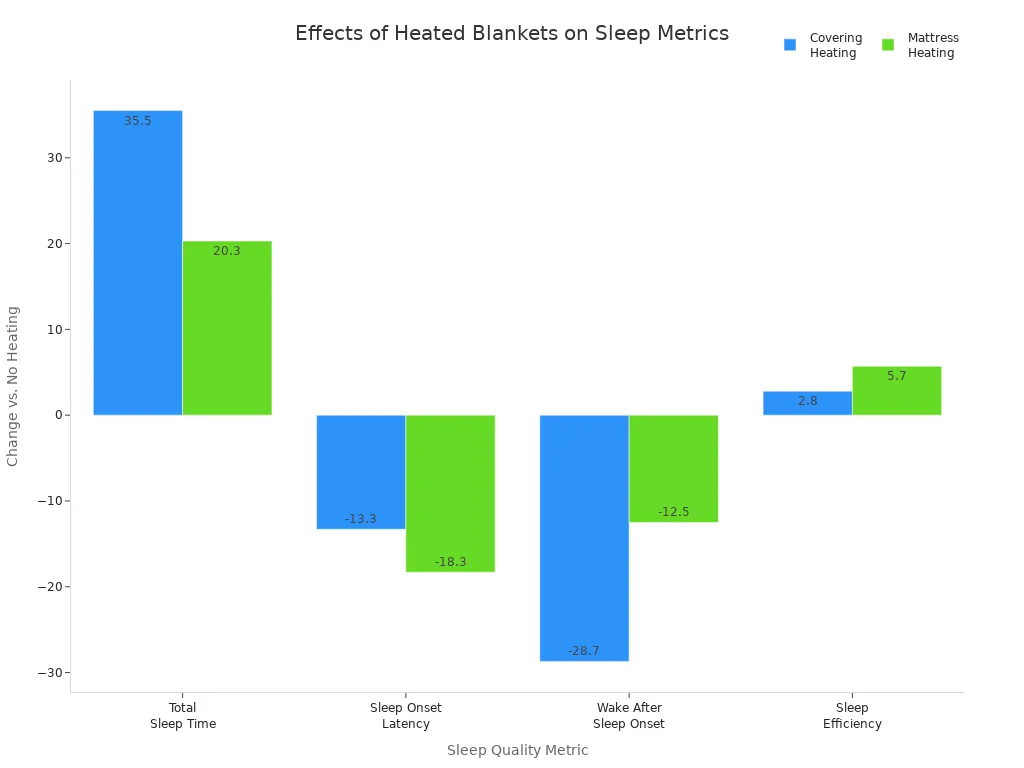
|
Metric |
Covering Heating |
Mattress Heating |
No Heating |
|---|---|---|---|
|
Total Sleep Time (minutes) |
35.5 |
20.3 |
N/A |
|
Sleep Onset Latency (minutes) |
-13.3 |
-18.3 |
N/A |
|
Wake After Sleep Onset (minutes) |
-28.7 |
-12.5 |
N/A |
|
Sleep Efficiency (%) |
+2.8 |
+5.7 |
N/A |
|
Systolic Blood Pressure (mmHg) |
Lower |
N/A |
N/A |
You can achieve better sleep by using heated blankets to create a stable, comfortable environment. The warmth helps you fall asleep faster, stay asleep longer, and wake up feeling refreshed. If you struggle with maintaining your ideal sleeping temperature, heated blankets offer a practical solution for improving sleep and enhancing relaxation.
Note: Heated blankets are most effective when you adjust the settings to match your comfort needs. You should monitor your body's response and make changes as needed for optimal relaxation and better sleep.
Usage Scenarios:
- You live in a cold climate and want consistent warmth for better sleep.
- You experience muscle soreness or chronic pain and need gentle relief.
- You struggle with anxiety or stress and seek relaxation before bedtime.
- You want to improve sleep quality by maintaining your ideal sleeping temperature.
Energy Efficiency and Cost Savings
Heated Blankets vs. Room Heating
You want to stay warm during cold nights, but you also want to keep your energy bills low. Heated blankets offer a smart solution by providing direct warmth to your body, unlike central heating systems that must heat entire rooms. Electric blankets use targeted heat, which maximizes efficiency and minimizes waste. When you use heated blankets, you avoid the common problem of heat loss through poor insulation or unoccupied spaces.
Consider the following comparison:
|
Aspect |
Heated Blankets |
Central Heating Systems |
|---|---|---|
|
Energy Consumption |
Significantly lower |
Higher due to heating entire spaces |
|
Heating Method |
Targeted heating |
Heats entire rooms |
|
Efficiency |
Maximizes efficiency, minimal waste |
Less efficient, heat loss common |
|
Cost Savings |
Reduces heating bills |
Higher utility bills |
|
Carbon Footprint |
Lower due to reduced energy use |
Higher due to overall energy consumption |
Electric blankets deliver warmth directly to you, so you do not need to raise the thermostat for the whole house. This approach leads to substantial savings on heating bills. Lowering your thermostat by just one degree for eight hours can save you about 1% on your energy bill. Heated blankets help you achieve comfort without sacrificing efficiency.
Lower Energy Bills
You can see real savings when you switch from room heating to heated blankets. Electric blankets use much less power than space heaters or central heating. For example, a small heated blanket uses only 50 to 100 watts, costing about $0.06 to $0.12 per night. A king-size heated blanket with dual controls may cost up to $0.24 per night. In contrast, running central heating for the same period costs much more.
|
Blanket Size |
Typical Wattage (Watts) |
Cost per Night ($) |
|---|---|---|
|
Small/Throw Blankets |
50 - 100 |
~0.06 - 0.12 |
|
Full Size (Single Control) |
~100 |
~0.10 |
|
King Size (Dual Control) |
Up to 200 |
~0.24 |
Utility reports show that using heated blankets can save you $150 to $175 in the first year. If you lower your thermostat by 8°F for 24 hours a day over 25 weeks, you could save an average of $233. The cost of electricity for using heated blankets eight hours a night for 25 weeks is only about $15.
Tip: Use heated blankets to stay warm and lower your thermostat. You will reduce your carbon footprint and enjoy significant savings on your energy bills.
You benefit from efficient heat, lower costs, and a more sustainable home environment. Heated blankets provide comfort and warmth while helping you manage your household budget.

Choosing the Right Heated Blanket
Choosing the best heated blanket for your needs improves warmth, comfort, sleep quality, and safety. Before buying, compare the features below to find the right electric blanket for your bed and lifestyle.
| Factor | Description |
|---|---|
| Size | Choose from throw, twin, full, queen, or king sizes based on your bed, intended use, and storage space. |
| Heat Settings | Multiple heat settings provide better temperature control for personalized comfort and consistent warmth. |
| Control | Look for easy-to-use wired or digital controls with auto shutoff and timer functions for convenience and safety. |
| Voltage | Low-voltage heated blankets can offer added safety, but they may take longer to warm up. |
| Plug Cord | Check cord length and plug placement to ensure safe, comfortable use without stretching or bending the cord. |
| Materials | Fire-resistant polyester is common and practical. Avoid cotton models when possible, as they may be less suitable for electric heating use. |
| Care | Machine-washable heated blankets are easier to maintain, but always follow the manufacturer's cleaning instructions. |
| Price | Higher-priced models often include more safety features, better controls, and improved durability. |
Tip: Prioritize a heated blanket with auto shutoff, multiple heat settings, and easy-care fabric for safer, more comfortable use.
Proper Use and Settings
Using a heated blanket correctly helps improve sleep comfort while reducing safety risks. Start on a low heat setting and increase gradually until you find a comfortable temperature. Use the timer or auto shutoff feature so the blanket turns off automatically, which can help prevent overheating and save energy. Pre-heating the blanket before bedtime can provide instant warmth and help you relax before sleep. Increase the temperature slowly to avoid hot spots and support even heating. Always inspect the blanket for signs of wear before use.
Start with a low setting and adjust gradually for comfort.
Use the timer or auto shutoff for safer operation.
Pre-heat the blanket before bedtime for immediate warmth.
Check for damage before each use.
Cleaning and Maintenance
Proper heated blanket care helps extend product life and maintain safe performance. Follow these steps for cleaning and maintenance:
Detach the power cord and controls before washing.
Use a gentle cycle with cold water, or hand wash with mild detergent.
Remove excess water by rolling the blanket in a clean towel.
Dry on low heat or air fluff, keeping the blanket flat when possible.
Rinse thoroughly to remove detergent residue.
Air dry on a towel away from direct sunlight.
Make sure the blanket is completely dry before using or storing it.
Note: Always check the manufacturer's instructions for specific washing and drying guidelines.
When to Replace a Heated Blanket
Most heated blankets should be replaced every 5 to 10 years to maintain safety and reliable performance. Regular inspections can help you catch problems early. Replace your blanket immediately if you notice frayed wires, burn marks, uneven heating, overheating, unusual odors, faulty controls, or reduced heat output. Older blankets may also lack newer safety features and updated standards.
Inspect your heated blanket regularly for signs of wear or damage.
Replace it immediately if you notice malfunction or overheating.
Upgrade every 5 to 10 years for safer, more consistent warmth.
Tip: Replacing an old heated blanket helps you benefit from newer safety features, improved controls, and more reliable heating.
FAQ
Can you leave an electric heated blanket on all night?
You can leave an electric heated blanket on all night if it has an auto-off feature. You should check the manufacturer's guidelines. Many electric models include safety features that prevent overheating. Always inspect your electric blanket for damage before each use.
Do electric heated blankets help with anxiety and sleep?
You may experience reduced anxiety and improved sleep when using electric heated blankets. The gentle warmth creates a calming effect. Electric heated blankets and weighted blankets both provide comfort. Many users report better relaxation and less anxiety at bedtime.
Are electric heated blankets safe for children?
You should avoid using electric heated blankets for children. Children may not recognize overheating or burns. Electric models pose risks for young users. Weighted blankets offer a safer alternative for warmth and comfort. Always consult a pediatrician before introducing electric heated blankets.
How do electric heated blankets compare to weighted blankets?
Electric heated blankets provide direct warmth and adjustable heat settings. Weighted blankets offer deep pressure stimulation, which helps reduce anxiety. You can use both for comfort, but electric heated blankets focus on temperature control. Weighted blankets target anxiety and relaxation.
What maintenance does an electric heated blanket require?
You should unplug your electric heated blanket before cleaning. Follow the manufacturer's instructions for washing and drying. Inspect the electric blanket for frayed wires or damage. Replace your electric heated blanket every five to ten years. Proper care ensures safety and comfort.