

The Edge Effect Explained
Many users report that even when the central area of an electric blanket heats evenly, the blanket as a whole still feels less comfortable than expected. Edge zones influence overall comfort disproportionately because they concentrate temperature gaps, structural irregularities, and frequent body contact - all in regions where human perception is especially alert to deviation.
Typical observations include:
- A slightly cool border makes the entire blanket feel underheated
- A stiff or under-filled edge weakens the sense of being wrapped in warmth
- A warm center alone does not produce a fully comfortable night's sleep
Comfort depends on uniformity across the whole surface, not central performance alone. For the technical background, the operating principles of electric blankets offer a useful starting point.

Why Edges Heat Differently From the Center
Thermal Losses at the Perimeter
The perimeter of an electric blanket is thermodynamically disadvantaged. The heating wire is not routed to the outermost edge, for safety clearance and durability. The perimeter also has a higher ratio of exposed surface to ambient air, which accelerates heat loss.
Three consequences follow: slower warm-up at the edge, a lower steady-state temperature, and an uneven thermal gradient between the center and the border. The effect grows stronger toward the outer boundary, which is why a warm core can coexist with a distinctly cool edge.
The Role of Binding Construction
Binding zones use thicker material, denser stitching, and tighter construction than the blanket body. This restricts heat transfer while also reducing softness and drape.
Edge discomfort is therefore rarely a single attribute. It combines lower temperature, greater stiffness, and weaker conformity - a compound sensation the body detects more readily than temperature alone. Internal wiring layout directly governs thermal uniformity, and its limits show up most clearly at the perimeter.
Edge-related discomfort is thermal and structural at the same time, never just one or the other.

Why Local Flaws Dominate Overall Judgment
Contact With Sensitive Body Zones
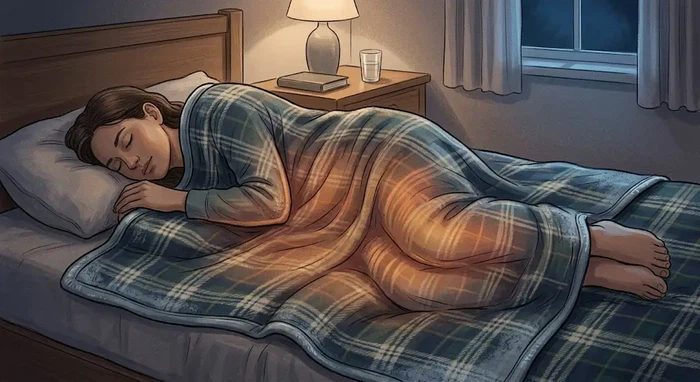
Typical sleep postures place shoulders, outer arms, outer legs, and feet near the blanket's perimeter. These regions are highly responsive to temperature and tactile cues, so edge deviation registers quickly.
Feet are the clearest case. As peripheral circulation endpoints, they react sharply to cold, and persistent coolness at the foot end is a common cause of disrupted sleep onset. The design logic behind dedicated foot-warming products illustrates why edge temperature carries so much weight.
Edge Contact Is Frequent, Not Occasional
Sleep involves continuous postural change - turning, rolling, curling, extending. Each movement brings new parts of the body into contact with the perimeter. Edge-related discomfort is recurrent rather than a one-time event.
Repeated low-grade discomfort accumulates into a stronger impression than a single sharp episode. The user may not identify the specific source, but the cumulative effect yields a clear negative impression of the product as a whole.
Perception Weights Anomalies Above Baseline
Normal performance fades from conscious awareness. Deviations are retained and weighted heavily. A stably heated center becomes perceptually invisible, while a cool or stiff edge stays memorable.
The final judgment is rarely worded as "the edge has a problem." It appears as a broader verdict: the blanket is uncomfortable. Localized flaws exert a disproportionate influence on global evaluation.
Implications for Design and Buying Decisions
Design Priorities Beyond Central Heating
Central heating performance is necessary but not sufficient. Edge transition, binding construction, and perimeter conformability are equally decisive for overall product evaluation. The border deserves treatment as a primary quality zone, not a finishing detail.
Fabric type materially affects edge comfort, with softer and more uniformly structured materials reducing negative perimeter sensations. The International Electrotechnical Commission (IEC) sets general requirements for heating uniformity and structural stability in household heating appliances. In practice, edge handling often influences perceived comfort more strongly than headline electrical specifications do.
A Buyer's Evaluation Checklist
Assessment should extend beyond central heating performance. Useful checks include:
- Whether the edge temperature deviates noticeably from the main surface
- Whether the binding feels stiff or uncomfortable against the skin
- Whether the perimeter feels hollow or under-filled
- Whether the edge drapes evenly and maintains body contact during movement
These characteristics are the strongest predictors of long-term sleep comfort. A broader methodology for evaluating electric blankets before purchase places these checks in wider context, so selection is not reduced to wattage and heat settings alone.

Summarize
The disproportionate role of edge zones comes from three factors converging at the perimeter: thermal deviation is most likely to appear there, structural differences in material and construction are most visible there, and contact with sensitive body parts is most frequent there.
The center establishes baseline warmth. The edge establishes whether the overall experience feels complete. Edge zones shape the user's verdict on comfort - not just local temperature.