
When sourcing or selecting an electric blanket, the key concerns are always the same: how fast does it heat up, how much energy does it consume, how safe is it, and does it fit the intended use case? Yet most product descriptions barely scratch the surface of heating technology, offering little that actually supports informed purchasing or procurement decisions.
There are currently three mainstream heating solutions used in electric blanket manufacturing: carbon fiber heating elements, resistance wire heating elements, and composite far infrared heating systems. These are not simply upgraded versions of one another. Each corresponds to a distinct cost structure, performance ceiling, and target market. Understanding these differences matters far more than marketing language.
What determines whether an electric blanket performs well goes beyond the heating material itself. The precision of the temperature control chip, the density of sensor placement, the insulation layer design, the overheat protection mechanism, and the overall assembly quality all have a significant - sometimes even greater - impact on real-world performance.
Three Types of Electric Blanket Heating Technology
Carbon Fiber Heating Elements
Carbon fiber electric blankets use carbon fiber filaments or woven carbon fiber tape as the conductive heating element, converting electrical energy into heat and transferring it across the blanket surface. The filament diameter typically ranges from 5 to 10 microns, and the weave density and denier count directly affect heating uniformity and flexibility. Higher weave density and finer filaments produce more even heat distribution, though manufacturing costs rise accordingly.
Carbon fiber is naturally flexible, conforms well to the body, and is ideal for uniform surface heating and sustained temperature control. In the mid-to-high-end heated blanket market, carbon fiber solutions are steadily gaining share among both manufacturers and wholesale buyers.

Far Infrared Heating Systems
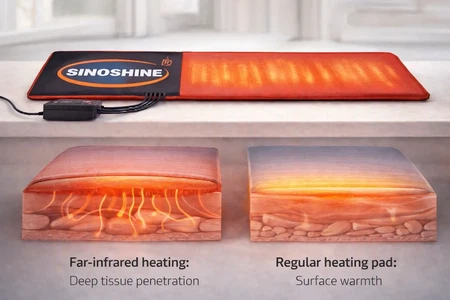
Far infrared is not an independent heating material - it is a thermal radiation effect produced during the heating process. So-called "far infrared electric blankets" still rely on an underlying heating element such as carbon fiber, graphene heating film, or another conductive material. The product positioning simply emphasizes the far infrared wavelength band, usually labeled between 4 and 16 microns.
In other words, far infrared is more of a functional marketing label than a standalone technology. Its actual performance ceiling is entirely determined by the base heating structure and the temperature control system. Buyers who treat "far infrared" as an automatic indicator of superior quality risk falling into a concept trap.
Resistance Wire Heating Elements
Resistance wire is the most mature technology in the electric blanket industry. It works by running current through nickel-chromium or copper-nickel alloy wire, generating heat that is conducted outward through the fabric and fill layers. Common wire gauges range from 0.3 mm to 0.5 mm, with power density adjusted based on wire spacing and diameter.
The advantage of resistance wire electric blankets lies in the mature supply chain, stable raw material availability, and low barrier to entry for production. It remains the dominant solution in mass-market and price-sensitive segments. However, its limitations are equally clear: the wire is rigid, layout density is constrained by cost, and lower-end products are prone to uneven heat zones.

Emerging Technology: PTC Self-Regulating Heating Materials
In recent years, PTC (Positive Temperature Coefficient) self-regulating heating materials have entered the mid-to-high-end electric blanket market. The defining characteristic of PTC elements is that resistance increases sharply as temperature approaches a set threshold, causing power output to drop automatically. This provides overheat protection at the material level, without relying on external temperature control circuitry - offering a higher degree of safety redundancy. PTC solutions currently carry a cost premium and have limited market penetration, but they are worth watching for electric blanket manufacturers exploring next-generation product lines.
Core Differences: Carbon Fiber vs. Resistance Wire vs. Far Infrared
| Comparison Dimension | Carbon Fiber | Far Infrared Composite | Resistance Wire |
|---|---|---|---|
| Heat Distribution | Excellent - surface-area heating with temperature variance within ±2°C | Varies widely depending on the base heating element | Linear heating - low-end products may show 3–5°C temperature variance |
| Heating Speed | Fast - most products reach set temperature in 5–10 minutes | Moderate to fast, depending on the base element's power density | Moderate - high-power models heat quickly but lack uniformity |
| Temperature Stability | High precision with NTC sensors - fluctuation within ±1°C | Depends on control system configuration | Basic models use stepped settings with wider fluctuations |
| Softness and Flexibility | Excellent - carbon fiber is pliable and fold-resistant | Moderate to good | Average - metal wire has inherent stiffness and risk of breakage from repeated bending |
| Lifespan | Long - 5+ years under normal use | Depends on base material and connector build quality | Moderate - low-end products show increased aging risk after 2–3 years |
| Power Range | Single: 60–80W; Double: 100–150W | Matches the base heating solution | Single: 50–80W; Double: 80–150W |
| Safety Ceiling | High - material is inherently resistant to localized overheating | Depends on overall product design and protection systems | Depends on design - higher risk in low-end products |
| Cost | Higher - retail pricing typically 30%–50% above resistance wire products | Moderate to high | Low - the go-to for cost-driven markets |
| Target Market | Mid-to-high-end residential, wellness, branded products | Functional differentiation, wellness, gift channels | Mass market, promotional, price-competitive segments |
In-Depth Comparison: Heating Efficiency, Lifespan, and Energy Consumption
Heating Efficiency
Carbon fiber delivers surface-area heating, releasing warmth evenly across the entire heating zone - virtually eliminating noticeable hot and cold spots. Resistance wire, by contrast, generates heat along individual lines. The wider the wire spacing, the more pronounced the temperature drop between lines. At equivalent wattage, a carbon fiber electric blanket typically covers 20%–30% more effective heating area than a resistance wire model, which directly translates to better comfort.
Resistance wire products are not necessarily slow to heat up - high-wattage configurations can reach temperature quickly. But speed and uniformity are two different things. A blanket that heats fast but creates hot spots often feels less comfortable than one that heats slightly slower but distributes warmth evenly. For electric blanket suppliers positioning products in the comfort-driven segment, this distinction is critical.
For far infrared products, efficiency cannot be judged by the label alone. What matters is the underlying heating element, the power density, and the precision of the temperature control system. If the base heating solution is mediocre, the "far infrared" tag does not change the physics.
Lifespan
Carbon fiber filaments demonstrate significantly better long-term stability than metal resistance wire under repeated bending and daily use. Carbon fiber is immune to metal fatigue, and a lifespan of five years or more is a reasonable expectation under normal conditions.
Resistance wire product lifespans vary enormously. High-quality models with dual-layer insulation and bend-resistant alloy wire can last 3 to 5 years. But budget products that cut costs on wire quality, winding technique, and protective layers frequently exhibit wire breakage, aging, and insulation degradation within two years. This variance creates real implications for bulk electric blanket procurement - selecting the wrong tier of resistance wire product can lead to elevated return rates and after-sales burden.
Far infrared product lifespan cannot be assessed independently. It is entirely determined by the base heating element - whether carbon fiber or resistance wire - and the build quality of connectors and controllers.
Energy Consumption
When equipped with effective constant-temperature control, carbon fiber electric blankets achieve a favorable balance between comfort and power consumption. Surface-area heating transfers warmth more efficiently, meaning lower wattage is needed to reach the same perceived temperature. A double-sized carbon fiber heated blanket running in constant-temperature mode typically consumes 50–80W, translating to roughly $0.04–$0.07 per eight-hour overnight session.
Resistance wire products are perfectly adequate for basic heating. However, due to limited temperature control precision, many models cycle between "high" and "low" settings, resulting in actual energy consumption 15%–25% higher than a same-size constant-temperature carbon fiber product.
Far infrared product energy performance, once again, depends on overall system design - not the marketing label.

SINOSHINE Advanced Heated Blanket Technology
A Comprehensive Guide to Customization Excellence in Modern Manufacturing
Safety and Temperature Control
Many consumers equate safety with material advancement - assuming a "better" material automatically means a safer product. This is a misconception that deserves correction. Electric blanket safety is a systems-level issue; the heating material is only one variable. A carbon fiber electric blanket without overheat protection still poses a risk. A resistance wire electric blanket with robust temperature control and protection can meet safety standards with confidence.
Under China's national standard GB 4706.8 - and aligned with IEC 60335-2-17 for international markets - electric blankets must pass overheat protection testing, dielectric withstand testing, leakage current testing, and other safety validations. Verifying 3C certification (or equivalent regional certification) is the absolute baseline for any purchasing decision, whether for retail consumers or commercial electric blanket buyers.
Overheat Protection
Regardless of whether the heating solution is carbon fiber, resistance wire, or far infrared composite, overheat protection is non-negotiable. The standard approach is to embed thermal fuses within the heating layer that automatically cut the circuit when localized temperature exceeds a set threshold - typically 65–75°C. Higher-end products implement multi-layered protection: thermal fuse plus real-time NTC thermistor monitoring plus controller-level software temperature limiting, forming a three-tier safety system. For electric blanket OEM buyers, specifying the protection tier should be a standard part of the sourcing checklist.
Constant-Temperature Control
Temperature regulation precision directly determines safety and comfort during extended overnight use. High-accuracy constant-temperature systems rely on NTC sensor sampling frequency and advanced control algorithms, capable of holding temperature fluctuation within ±1°C. Low-end stepped-control products offer only high, medium, and low settings, with wide temperature swings between levels - leading to an uncomfortable hot-cold cycling sensation and increased risk of overheating during sleep.
Auto Shut-Off Timer
An auto shut-off function significantly reduces the risk of forgetting to turn off the blanket. In households, student dormitories, hotel rooms, and senior care facilities, timed power-off is no longer a bonus feature - it is a necessary configuration. Products supporting 1–12 hour timer settings should be prioritized.
Wiring and Insulation Design
The heating element is just one core component. The insulation material of the wiring, the connector interface between heating wire and controller, moisture barrier design, flame-retardant fabric rating (compliant with GB/T 17591 or equivalent international fire-resistance standards), and the flame-retardant and waterproof rating of the controller housing - all of these affect overall product safety as much as the heating material itself. Electric blanket manufacturers and sourcing teams should evaluate these structural details as carefully as the headline heating technology.
Dual-Zone Temperature Control
Dual-zone temperature control is especially valuable for queen- and king-size electric blankets shared by two sleepers with different warmth preferences. For products positioned in the mid-to-high-end residential market, dual-zone control provides more practical value than simple high-low stepped settings and supports a higher price point.
Pros and Cons of Each Heating Technology
Carbon Fiber Electric Blankets
Advantages
Surface-area heating delivers uniform heat distribution and consistent body-feel warmth. The material is flexible and fold-friendly, maintaining performance through storage and daily use. Carbon fiber integrates naturally with constant-temperature control, dual-zone heating, and multi-layered protection systems - offering the highest system-level integration ceiling. Unlike metal wire, carbon fiber filaments are not subject to metal fatigue, resulting in superior long-term durability.
Disadvantages
Manufacturing costs run 30%–50% higher than resistance wire solutions, and retail pricing reflects this. If the temperature control system is not up to par, the material advantage is largely wasted - premium material paired with a poor control system equals underperformance. The market also contains products using low-specification carbon fiber while claiming high-end status, so verifying heating element specifications during procurement is essential.
Best Fit
Household consumers who prioritize comfort, safety, and long-term reliability. Brands and channel partners building a mid-to-high-end heated blanket product line.
Far Infrared Composite Electric Blankets
Advantages
The functional label creates a clear market differentiation angle, making it easier to enter wellness, senior care, and therapeutic-adjacent segments. The concept has strong appeal in gift channels and health-oriented retail, supporting differentiated positioning and premium pricing.
Disadvantages
Heavy reliance on concept-driven marketing means consumers may misread "far infrared" as an absolute performance advantage. Actual user experience depends entirely on the base heating element and the temperature control system. If the underlying solution is average, the far infrared label delivers no tangible improvement. Procurement decisions should focus on temperature control accuracy and safety certifications, not feature labels.
Best Fit
Businesses pursuing differentiated product lines, functional gift items, wellness-adjacent categories, or brand-upgrade strategies. Consumers should not treat "far infrared" as a standalone purchasing criterion.
Resistance Wire Electric Blankets
Advantages
The most mature manufacturing process, the widest supplier base, and the most competitive pricing. Resistance wire electric blankets are well suited for large-scale production and strict cost control. They remain highly competitive in budget-oriented markets and among price-sensitive buyers.
Disadvantages
Linear heating inherently produces less uniform heat distribution compared to carbon fiber. Lower-end products are prone to localized overheating and noticeable temperature variance. Metal wire is susceptible to breakage from repeated bending, and aging accelerates significantly in budget-tier products. If temperature control and safety protection are underspecified, the risk profile is higher than carbon fiber alternatives.
Best Fit
Price-sensitive markets, promotional campaigns, student housing, rental properties, and basic commercial applications. Businesses pursuing volume through low-cost distribution - though overheat protection and certification should never be sacrificed to save on unit cost.

Learn about SINOSHINE products
Explore the full range of SSHINE® professional-grade electric heating products-safety, comfort, and reliability are at the heart of our products. Our catalog includes smart electric blankets, multi-functional heating pads, foot warmers, heated lumbar belts, neck and back heating pads, and more, designed to meet your needs for home heating, health, and everyday comfort.
Choosing by Commercial Application
Residential Retail Market
Carbon fiber is the recommended priority. Home users have high expectations for comfort, heat uniformity, quiet operation, and overnight temperature stability. Carbon fiber holds structural advantages across all these dimensions. Paired with constant-temperature control and auto shut-off, it covers the vast majority of household needs.
Hotels, Dormitories, and Rental Properties
Resistance wire solutions with full safety protection features - or mid-tier constant-temperature models - are the practical choice. These scenarios prioritize unit procurement cost, bulk delivery capability, and ease of maintenance. However, one principle must hold firm: overheat protection and auto shut-off are non-negotiable. Cutting safety features to hit the lowest possible unit price creates after-sales and liability exposure that far outweighs the savings. For hospitality electric blanket sourcing, safety compliance should be a line item, not an afterthought.
Senior Care and Wellness Facilities
Carbon fiber is the preferred solution, with far infrared composite options available for differentiation. These environments demand high temperature stability, extended use cycles, and cater to elderly users with heightened temperature sensitivity. Budget-tier products are not appropriate as a primary solution. Dual-zone temperature control and multi-period timer functions are recommended additions.
Gift and Functional Retail Channels
Far infrared composite solutions are a natural fit. Channels that need strong functional branding, enhanced product recognition, and room to command premium pricing benefit from the far infrared concept's communication power and differentiation potential.
E-Commerce Price-Competitive Markets
Resistance wire offers the most controllable cost base and works well for entry-level traffic-driving SKUs. However, from a long-term store operation perspective, products equipped with constant-temperature control, auto shut-off, and overheat protection consistently show lower return rates and fewer negative reviews. In an e-commerce environment where review ratings carry increasing weight, a pure low-price volume strategy is becoming harder to sustain.
Key Selection Criteria for Buyers
Whether sourcing for personal use or for bulk commercial procurement, the following checkpoints should guide every electric blanket purchasing decision:
- Does the product support constant-temperature control?
- Does it include overheat protection and auto shut-off?
- Is the heating uniform, with minimal risk of localized hot spots?
- Is the blanket soft and flexible enough that folding does not affect performance?
- Will the product deliver stable, reliable performance over extended use?
- For commercial buyers - does the product balance unit cost against failure rates and after-sales support requirements?
Summary and Recommendations
Carbon fiber electric blankets excel in heat uniformity, body-feel comfort, temperature control integration, and long-term durability - making them the top choice for mid-to-high-end residential use and extended-use scenarios.
Far infrared electric blanket solutions offer value primarily in product positioning and market differentiation. They are well suited for wellness, gift, and functional product categories - but should not be interpreted by consumers as a direct performance metric.
Resistance wire electric blankets hold a definitive advantage in cost and supply chain accessibility, making them ideal for mass-market and price-competitive categories. However, safety configuration and build quality must never be compromised to reduce unit cost.
Choosing an electric blanket is not about choosing a material name - it is about evaluating the complete product: heating performance, temperature control precision, safety protection tier, and alignment with the intended use environment. From a commercial standpoint, none of the three technologies is universally superior. What matters is whether the product positioning is clear, the cost structure is sound, and the target customer is genuinely matched.