

SINOSHINE believe that in an office setting, Feet Warmers for Office are not only heating appliances, but also "office accessories" that stay under desk for long-term daily use-i.e., foot heaters under desk designed for everyday workplace scenarios. Users' expectations are not just heating-they need a mature finished electrical appliance that is reliable, quiet, durable, and does not disturb the user. Therefore, driven by a user-experience-oriented product goal, SINOSHINE starts from five dimensions: noise reduction, appearance and tactile quality, temperature-control experience, cord length and cable routing, and syst

Noise R
Noise is one of the key factors that significantly affects user experience when using Feet Warmers for Office, especially for a foot heater under desk that runs quietly throughout the workday. This requires us to prioritize a low-noise architecture and control vibration and electric
PTC + large-area heat conduction is our preferred choice. We use aluminum profiles for heat spreading, so during heating the surface is mild-delivering a stable experience that users expect from an under desk foot warmer, rather than the uneven hot-spot feel some solutions may associate with an under desk heating pad.
Structurally, there are fewer moving parts, which is naturally low-noise, and maintenance will also be much less. It will not cause customers' skin to become overly dry or produce scalding/hot-spot phenomena. In terms of noise, we can achieve ≤25
Appearance
We enhance restraint and consistency of the office environment in CMF and interaction design, so the product can live naturally in an office scene as a desk foot heater. The visual effect adopts low-saturation neutral colors (dark gray / beige white / black), avoiding bright red or bright blue. In terms of form, we keep it as low-profile as possible, with large rounded corner
For materials, the housing uses PC/ABS with a fine matte texture, and the foot-contact surface uses fabric fi-supporting the long-contact feel expected of a heated footrest / footrest heater form factor.
In user experience, we hide screws as much as possible, keep seams uniform, and hide the logo. The underlying light is soft and not glaring. Buttons and knobs are consistent, avoiding looseness. We provide a cable routing groove, and the cord outlet uses an integrated protective sleeve and hazard-release (strain relief / pull-out safety release).
Temperature-Control Experience
For temperature control, we deliver stable temperature, safe touch, and responsive heating immediately after turning on-what users look for in an electric foot warmer for desk-but without aggressive "surging."
In the temperature-control structure, heating uses PTC. For sensing, there are two temperature points distributed at the heating element and the air outlet.
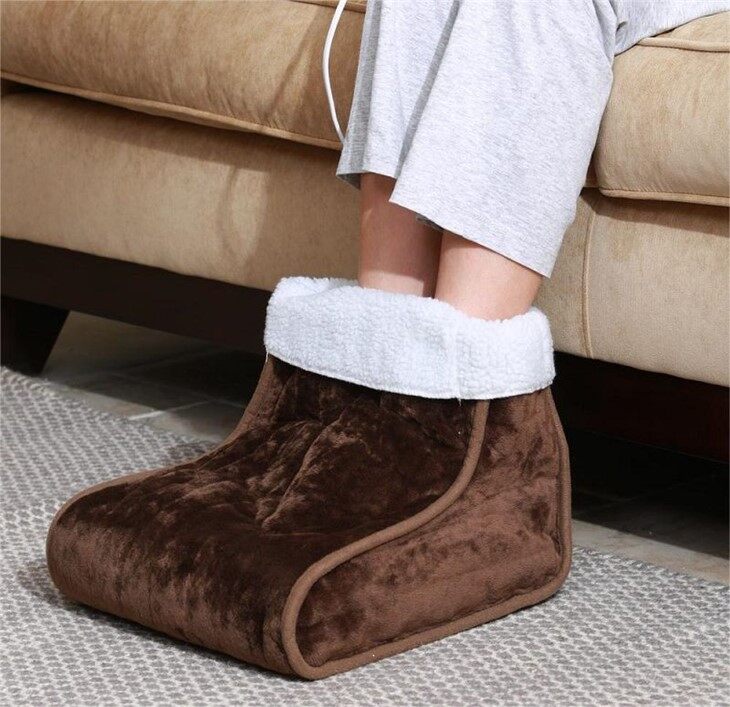
Feet Warmers for Office
Product size (CM): 30X30X23
Power: 100W
Number of stalls: 3
Product features: Inner sleeve can be disassembled and washed, overheat protection and fixed timing auto-off
MOQ: 3000 pieces
Color: gray, white, black, pink, etc., can support customization
Temperature ranges
Comfort temperature: 40–45°C, suitable for daily feet warmer for desk comfort
Enhanced heating temperature: 48–52°C (with time limit set to avoid user discomfort)
Surface upper temperature limit: ≤55°C, mainly used for keep-warm usage
Functions include: timer function (30/60/120-minute range settings); memory level; heating indicator light prompt, which flashes when a problem occurs.
Cord Length and Cable Routing
Cord length is generally 1.8m–2.5m, with 2.0m being the most common universal length-it will not be too short, and it will not be too long and difficult to store, meeting typical placement needs for an under desk foot heater.
For cord materials, it is cold-resistant, wear-resistant, and heat-resistant at an appropriate grade. The cord outlet has hazard-release, and there is multi-level overheat protection.
Safety Strategy
It includes MCU temperature limiting, independent over-temperature components, thermal fuses; automatic shutdown; cover or air-blockage protection; and flame-retardant materials.There are four layers of protection:
Software layer: temperature upper limit; sensor open-circuit or short-circuit detection; abnormal heating-up identification.
Hardware layer: independent temperature-control component (cuts off directly when over-temperature), not relying on MCU.
Instant protection: thermal fuse and other protections to cover abnormal phenomena.
Usage layer: timer and no-operation automatic shutdown to reduce the real risk of users forgetting to turn it off.
Cover and blockage protection: detects abnormal rotational speed, automatically reduces power or shuts down.
Materials and flame retardancy: the heat resistance and flame-retardant rating of the housing and key internal parts meet long-term high-temperature requirements.

FAQ
Can I step on it with shoes, or only with socks?
For "heated pad / heated foot pad" types: it's usually suitable for wearing socks; stepping on it with hard-soled shoes may affect the feel and may also speed up surface wear. For enclosed "heated foot pouch / foot warmer" types: it's more intended for wearing socks and putting your feet inside.
If there are pets/children in the office or at home, how should I place it more safely?
Keep a safe distance around the heat source, keep it away from flammable items, and try to prevent children/pets from getting close to it or playing with the power cord.
What's the difference compared with a small space heater?
Under-desk foot warming is more "localized direct heating." The goal is to keep the feet and lower legs comfortable, rather than heating up the whole room; therefore, users can often get improved comfort at a lower power level.
If it gets alternately hot and cool, what should the user check first?
Check whether the outlet has power and whether the plug is fully inserted.
Check whether there are any items piled around it that block heat dissipation or airflow/intake.
Check whether the timer is enabled and has reached the auto-off time.
Check for any abnormal smell or abnormal overheating; if so, power off immediately and contact after-sales support.